
Letter from the Chair
One of the exciting things about this time of the semester is the “to read” list and the promise of time over the holidays to dive into those books. One of the things on my “to read” list is Rachel Blau du Plessis’ Life in Handkerchiefs, suggested to me by Megan Jewell; she and Martha Schaffer will be leading the department’s first-ever Study Abroad trip (to Dublin over Spring Break). Most new Study Abroad courses take at least a year to generate adequate student interest, but this one is completely full already with a 20-student waiting list. No surprise! I got to preview the syllabus, and it’s wonderful.
A second “to read” item on my list is inspired by Caren Beilin’s new novel Sea, Poison, which is in deep conversation with Shusaku Endo’s The Sea and Poison. Endo’s novel has been sitting on my desk for months now (along with the copy of Kevin Dettmar’s How to Chair a Department, given to me during New Chairs Orientation), and I’m determined to read it over Winter Break. I’m hoping that thinking about Caren’s contemporary allusions to Endo will help me reflect on the contemporary allusions to Harlem Renaissance literature that are the focus of my new monograph.
A third book on my possibly-too-ambitious holiday pleasure reading list is inspired by Rohan Chhetri, our Anisfield-Wolf Distinguished Visiting Writer, who will be here in the Spring. I read Chhetri’s beautiful book of poems Lost, Hurt, or in Transit Beautiful during the visiting writer selection process. And now want to read his translations of Shreela Ray’s poems. FYI: Rohan will be doing a poetry reading in the Colloquium series on Friday, February 13th, 2026, which feels like an early Valentine. Speaking of which, I just learned that a bunch of undergrads are reading (or re-reading) Wuthering Heights in anticipation of Emerald Fennell’s film adaptation, which debuts on Valentine’s Day. So I might hop on the Brontë bandwagon over the holidays, too . . .
The other thing on my “to read” list is a movie: KPop Demon Hunters, inspired by a podcast episode that Jeannelle (a freshman in my podcasting class) created. Jeanelle’s podcast focuses on missed character development opportunities and flaws in the movie’s plot, and I wish I could share it with you because it’s smart and incredibly funny. Another team of student podcasters (Carlos and Sumaitaah) created a terrific episode in which they rank every Shakespeare play based solely on Chat GPT’s 10-word plot summaries of the Bard’s work. (Among their findings: it’s dangerous to rely on generative AI because you might end up thinking that Hamlet is an action story populated by multiple ghosts . . . and then go embarrass yourself in Maggie Vinter’s class).
My class is called “Podcasting Workshop: Shakespeare in Harlem” and it focuses on African American engagements of Shakespeare’s work. We started the semester with a This American Life episode called Act V about a production of Hamlet staged by incarcerated actors. Then we read two different non-fiction stories about Shakespeare by James Baldwin (including the 1964 essay “Why I Stopped Hating Shakespeare”) and did a deep-dive into Macbeth because the 1936 “Voodoo Macbeth” production in Harlem—with an all-Black cast, directed by a young Orson Welles—was the production that Baldwin saw as a teenager. The students this term did a lot of thinking about our contemporary relationships to canonical authors and their works, and swapped stories about racial typecasting in school plays, and argued about the best and worst Shakespeare adaptations (Danai Gurira’s 2022 Richard III in the Shakespeare in the Park series got unanimous thumbs up).
Also, we’ve talked a lot about what makes some art transcendently great. What is worth paying attention to. For Baldwin, it’s this:
“The greatest poet in the English language found his poetry where poetry is found: in the lives of the people . . . . It is said that his time was easier than ours, but I doubt it—no time can be easy if one is living through it. I think it is simply that he walked his streets and saw them, and tried not to lie about what he saw: his public streets and his private streets, which are always so mysteriously and inexorably connected; but he trusted that connection.”
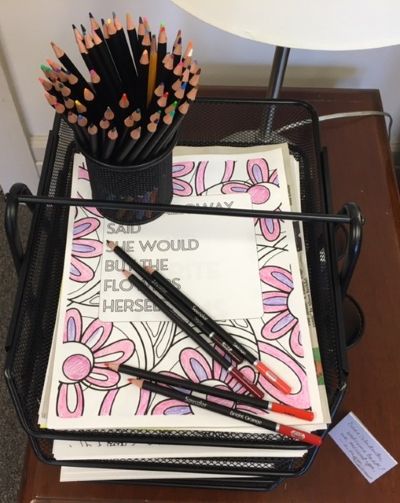
Here’s to transcendent greatness and evanescent fun, including the literary coloring pages we made for a “study break” corner of the Guilford Lounge (223) that are getting heavier use these days . . . as students are meeting up for study groups, and cramming for exams, and taking powernaps on the couch outside my office as the semester wends its way to a close.
All best,
Chi
P.S. We now have some free Dante allusion buttons that say “Nel mezzo” thanks to Thom Dawkins. And a full slate of Spring Colloquium events, including a lecture by Princeton faculty member Vance Smith (about a project that grew from his new book, Atlas’s Bones: The African Foundations of Europe), a book-in-progress talk about journalism by our own Ben Mauk, and a creative reading by three of our current graduate students: Juliana Amir, Abigail Raley, and Emily Sienkiewicz. Plus a National Poetry Month write-along and poetry workshop inspired by Taylor Swift’s song lyrics. So if you’re free and in the area on a Friday afternoon at 3:15, please come join us in the Guilford Parlor.
Anisfield-Wolf Distinguished Visiting Writer Named
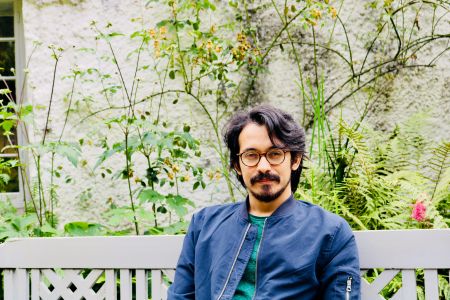
Rohan Chhetri is a poet and translator who earned a PhD from the University of Houston in 2023. For the past two years, he’s been a postdoc at Texas Christian University, where he taught Asian American and World Literature courses as well as creative writing workshops. Chhetri has an MFA from Syracuse University and did his undergraduate work at Mumbai University. He is a Kundiman Fellow who won the Kundiman Poetry Prize for his 2021 book Lost Hurt or In Transit Beautiful. He will be teaching two different ENGL 385 special topics classes called “Writing with Anisfield-Wolf” on Tuesdays and Thursdays here at CWRU in Spring of 2026; both are hybrid literature and creative writing seminars.
His poem “New Delhi in Winter” from his latest book.
New Gutenberg Annex Fall Updates

Book lab spaces have been a hive of activity this fall, with a return to regular workshops and individual student and faculty visits. In addition to significant organizational work across our Annex (Bellflower) and Exchange (Guilford) spaces, our lab has benefited from consultations with colleagues in Mechanical Engineering, in the Freedman Center, Kelvin Smith Library, and Think[Box]. Other highlights included
- A pop-up letterpress stand at the West Side Market, in conjunction with Inkubator
- Several community-oriented workshops, including a Rosh Hashanah celebration and work with the Bellflower Group (creative writers from across northeast Ohio)
- A visit from members of the College of Arts and Sciences Visiting Committee
- A feature in the President’s 2025 holiday video card
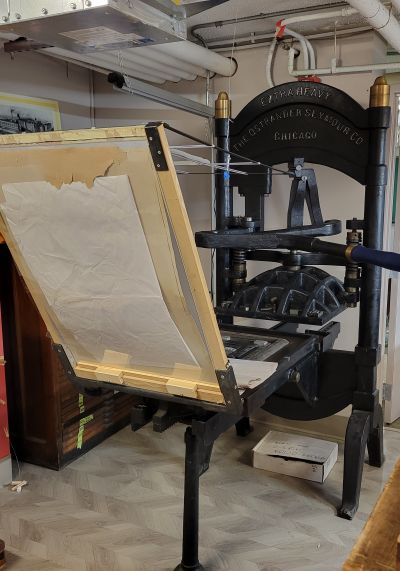
- Relocation and installation of our largest press, a recently acquired 3500-pound Ostrander-Seymour “Extra Heavy” press. The iron hand press, with the capacity to do fine book work, is named the “Woodmansee Critical Exchange Press” in honor of Professor Emerita of English Martha Woodmansee, her decades hosting the Society of Critical Exchange at CWRU, and her teaching of book history
Our interns continue to explore the range of things that can be accomplished in lab spaces, including testing out assignments and their sequencing for the spring 2026 inaugural offering of “How to Do Things with Books,” which is fully subscribed with a healthy waitlist. Interns have identified and proofed Cyrillic and Greek typefaces, made specimen sheets of paper with frame and deckle, produced decorative papers for binding (marbled and paste papers), and made boxed collections of saddle-stitched codices. Our shelves now include bespoke cased-in copies of Joseph Moxon’s two-volume Mechanick’s Exercises; or, the Doctrine of Handy-Works Applied to the Art of Printing (1683), including hand-marbled cover paper, as a result of preparations for spring student exercises.
In spring 2026, the lab will work to engage undergraduate students in the fabrication of type using new 3D printing and laser cutting tools. It will also introduce a new program that trains faculty to check out teaching collections of equipment, activities, and print materials to enrich their own classrooms – an “Annex on Wheels”! In the meantime, get in touch at letterpress@case.edu.
–Kurt Koenigsberger
2025 Summer Internships and Travel Research Funds
Each spring the English department invites applications for funds to support undergraduate internships and travel and research projects related to literature, film, journalism, or writing studies. In 2025, four students received support. Three of them completed outside internships at businesses that used their English know how and developed its use in the outside world.
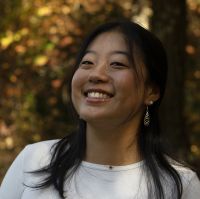
Chloe Chen was an editorial intern at Cleveland Review of Books where she did bookstore outreach, worked on their website, and took a deep dive into the short fiction inbox. Chloe came to appreciate “the revisions process and the need for a coherent voice/theme.” She especially prized shadowing the magazine editors’ processes.
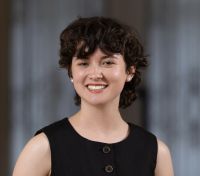
Vida Barzdukas interned for the Bring Together Lithuania (BTLT) program working on several projects such as website development for the Sasys Museum and acting as project manager for Tautiška Giesmė, a project designed “to bring Lithuanians around the world together to sing their national anthem.” Vida “designed the format and style of the video, which was then broadcast on the Lithuanian National Radio and Television program.”
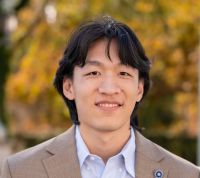
Lucas Yang worked at Ohio Magazine at a variety of tasks: “Ohio Magazine has the most rigorous fact-checking process . . . which meant I was responsible for identifying, highlighting, and confirming each individual assertion of fact I could find in these 300-500 word articles.” The stories ranged from an exhibit at the Cincinnati Art Museum about the parallels of food production and national identity to the creation of the world’s largest rubber duck in Brunswick, Ohio.
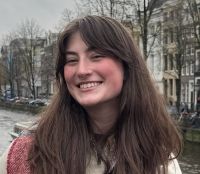
Lily Stuart, the fourth student to have her application approved, used her funds to travel to Spain this fall to do research for her capstone project. She notes, “Madrid is a hub for flamenco . . . . I expect to leave this experience with a more comprehensive understanding of Spanish popular culture (particularly live music performances) . . . and its capacity to evoke feelings of spirituality.”
These internships and research travel grants are made possible by the support of Tim O’Brien.
Fall Colloquium Visits
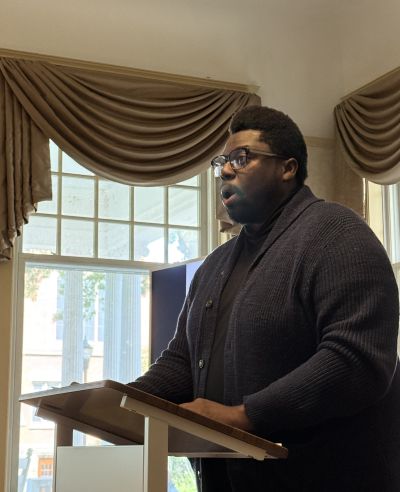
“Messages from Inner Space,” a Lecture by Adedotun Akintoye (Friday, September 19th).
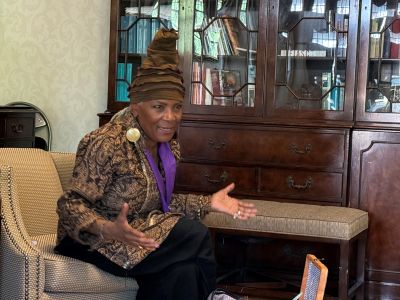
A Reading and Conversation with Poet Julie Ezelle Patton (Friday, September 26th).
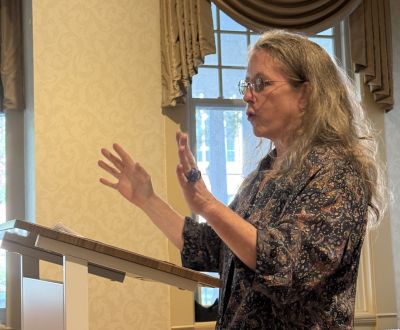
A Reading with Divagations and Conversation with Maureen McLane (Friday, October 3rd).
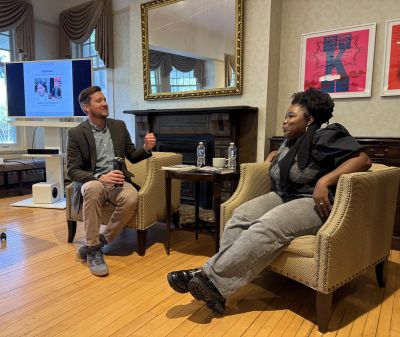
Matt Weinkam and Allegra Solomon in conversation at their reading (Friday, October 10th).
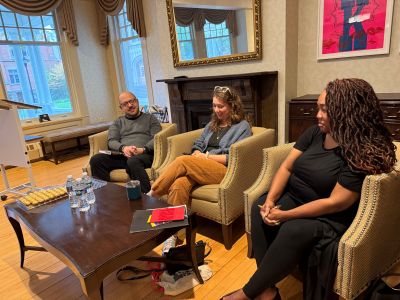
The Alumni Reading: Brad Ricca, Annie Nickoloff, Michelle Smith (Friday, October 24th).
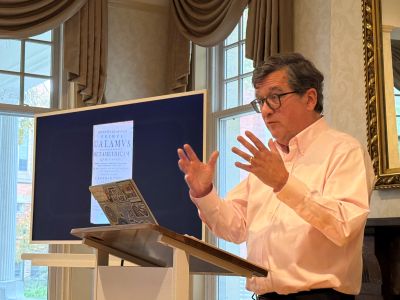
“When Artifice Is Knowledge,” a Lecture by Roland Greene (Friday, October 31st).
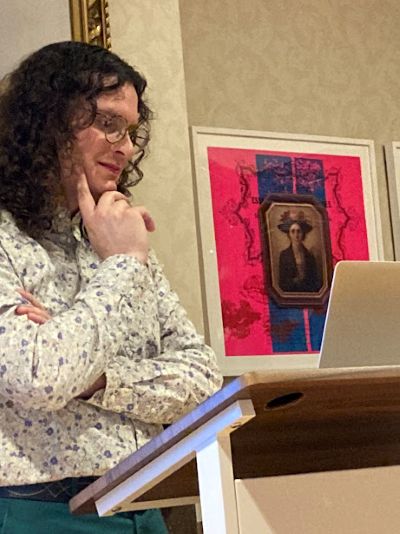
“Reading After the Clinic: Trans Pulp and the Generic Life of Gender,” a Lecture by Jo Giardini (Friday, November 7th).
Department News
Caren Beilin was in conversation with David Naimon, host of the literary podcast Between the Covers concerning her new novel at Powell’s Books in Portland, Oregon, on Sunday, November 2nd.

The Bellflower Group visited the New Gutenberg Annex on Saturday, October 25th.
The Flora Stone Mather Center for Women hosted Michelle Berger who presented “Writing Through the Dark: Trauma, Race, & Gender in Fiction” on November 5th.
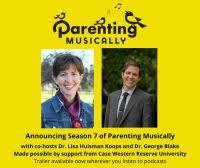
Parenting Musically, a podcast by George Blake and Lisa Huisman Koops, is now in its seventh season.
The Nursing Clio team, including former Managing Editor Vicki Daniel, has published its first edited volume with Rutgers University Press and its Critical Issues in Health and Medicine series. The Nursing Clio Reader includes short, accessible articles on the histories of sex, reproduction, and justice authored by leading scholars in the history of medicine.
Mary Grimm has a piece in the new issue of Gordon Square Review.
Walt Hunter discusses Nobel Prize winner László Krasznahorka.
At the Sixteenth Century Society conference, Denna Iammarino presented with her project team on their digital archive, The Artifacts of Capitalism. She also organized several panels and workshops as director of the Pedagogy and Digital Humanities tracks.
Megan Jewell published “On Draft 2.” A Restless Messengers Symposium on The Complete Drafts by Rachel Blau DuPlessis. Restless Messengers: Poetry in Review blog. Ed. Norman Finkelstein. July 2025.
Steve Justice published an article on Piers Plowman in Early Middle English.
On September 23rd, Kurt Koenigsberger gave a talk in the Department of English at Vanderbilt University to a group of graduate students, postdocs, and faculty.
The Aesop Project was performed on Saturday, November 22nd, with puppets designed by Ian Petroni, an animal-inspired score of Baroque music assembled by Les Délices director Debra Nagy, and a narrative by Ohio poet laureate Dave Lucas.
Alexandra Magearu’s article, “Governing Through the Language of Vulnerability: IOM’s Role in EU Border Externalization,” was published in Border Crossing. The text looks at the vulnerability discourses international organizations like the IOM use to classify, manage, and control displaced populations.
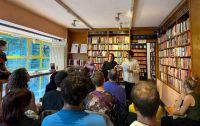
Ben Mauk moderated a discussion between philosopher Quill R. Kukla and writer Juliana Gleeson for the publication of Kukla’s new book, Sex Beyond “Yes”: Pleasure and Agency for Everyone, at Shakespeare & Sons Bookstore in Berlin, Germany.
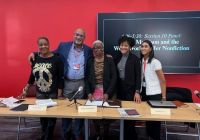
Marilyn Sanders Mobley (center), author of Toni Morrison and the Geopoetics of Place, Race, and Be/longing, at the Toni Morrison: Literature and Public Life symposium at Cornell University. On her left, moderator Carole Boyce Davies and Herman Beavers; on her right, Annabelle Haynes and Sasha Ann Panaram. Mobley’s paper was titled “The Third Space of Lament: Word-Work in Toni Morrison’s Non-Fiction.”
Srila Munukutla, a 3rd year undergraduate student minoring in creative writing, has had one of her poems, “Resting Position,” published in Lodestar Lit.
On Thursday, October 30th, Xixin Qiu had a work-in-progress talk at Baker-Nord: “Concept- and Genre-Based Writing Pedagogy: Provoking and Assessing Student Development.”
Camila Ring‘s article “Overhearing and Underseeing: Gerard Manley Hopkins and the Accident of the Poem” was published in the fall issue of Modern Philology. It can be accessed for a limited time without subscription here.
Lindsay Turner‘s third book of poems, Middle Slope, will be published by Farrar, Straus and Giroux in fall 2026.
An excerpt from Thrity Umrigar‘s upcoming novel Missing Sam (Jan. 27) was published in CrimeReads in October.
Maggie Vinter reviewed The Final Curtain: The Art of Dying on Stage by Laurence Senelick for Comparative Drama.
Alumni News
Iris Dunkle (’10) was part of the panel “Scribbling Women” Strike Back: How Long-Silenced Voices Have Fueled a New Resistance” — with Emily Van Duyne, Jessica Ferri, Kim Askew, Amy Helmes, Mimi Pond, and Jessi Haley on October 14th at Mrs. Dalloway’s in Berkeley, California.
Aparna Paul (’17) gave a poetry reading at Baker-Nord Institute for the Humanities on October 24th.
Much of alum (’80) Rick Pender‘s writing (and editing) has focused on the legendary musical theater composer and lyricist. He edited The Sondheim Review for 12 years. In 2021 his Stephen Sondheim Encyclopedia was published. On October 2nd, his latest book, Stephen Sondheim’s Sweeney Todd: Behind the Bloody Musical Masterpiece, was published by Bloomsbury Publishing.
Next year, narrative nonfiction writer Brad Ricca (’02) will teach classes, hold office hours, and participate in select library events as CCPL’s writer in residence. Ricca is the author of Lincoln’s Ghost: Houdini’s War on Spiritualism and the Dark Conspiracy Against the American Presidency and Super Boys: The Amazing Adventures of Jerry Siegel and Joe Shuster – the Creators of Superman (winner of the Ohioana Book Award).
Nardine Taleb (’17) gave a workshop on Saturday, November 15th: “Objects, Associations, and Memory.”
Send Me Your News
If you have news you would like to share in a future newsletter, please send it to managing editor Susan Grimm (sxd290@case.edu). If you wish to be added to our mailing list, just let us know. The department also has a Facebook page on which six hundred of your classmates and profs are already sharing their news. Become a member of the community and post your own news. We want to know. The department will be posting here regularly too—news of colloquiums, readings, etc. We tweet @CWRUEnglish. We are cwruenglish on Instagram.