
Letter from the Chair

One of the most reliable signs of spring here at Guilford House is the robin who insists on building a nest above the main double doors. The front porch is so quiet after exams. But this year, there was a wrinkle: the front door’s showing its age and the Facilities repair crew kept returning to test and fix the lock. In the process, they took down the nest. Twice. And each time, the robin rebuilt it, daubing on a little more mud to anchor it in place.
I admire that bird’s tenacity. And I like the snippets of conversations I overhear about its fierce sense of belonging. Also, I appreciate signs of continuity and new beginnings in this year when we’ll see the retirements of three valued colleagues: Susan Grimm, who joined the front office staff in 2010; and John Orlock and Thrity Umrigar, both of whom were recently awarded Emeritus status for exemplary scholarship and service. As a relative newbie, it’s hard to say goodbye to these folks who’ve welcomed me and shaped my sense of this community.
This term, amid their regular work and preparations for their next chapters, these three colleagues have quietly gone out of their way to give back to the department. Our understanding of where our majors are excelling and where they’re struggling is keener because John volunteered to read and assess undergraduate writing portfolios. Our Little Free Library had a major fiction refresh because Thrity sorted through her office shelves and gave the department first pick before her bookseller came. And the Grad Lounge is finally restored to something like its former glory because Susan handled a mountain of logistical work: scheduling our IT specialist to wipe the contents of a shockingly large assortment of old CPUs and electronics so they could then be donated to e-waste; putting in Facilities work orders to steam clean carpets and upholstery and discard all the broken office chairs and miscellaneous furniture that somehow migrated into the room; making sure the campus art conservators could get in and assess a large, insect-damaged oil painting that will probably be moved to President Kaler’s house; and coordinating the deliveries of new conference tables, chairs, and accessories, almost all of which were thwarted at least once by bad weather or the new campus door locking policy. Susan’s Grad Lounge Refresh to-do list was long! And she tackled it while doing other extra work to leave the English Department campsite cleaner than she found it: building a webpage for National Poetry Month writing prompts, and creating a raft of training resources for the new department assistant who will step into her shoes this summer.
None of our departing colleagues made a big deal about any of the myriad extra contributions they made this term. And they’ll probably be a little embarrassed to have a few of them enumerated here. But these folks set the standard for generous campus citizenship, and I want to celebrate that fact. I’m so happy for all of them and grateful to have had this too-brief chance to learn and work alongside them.
Collectively, we’ve gotten a lot done this year. Much of it has come to fruition in the spring. Caren Beilin just earned tenure; her application sailed through the review process thanks to her brilliant work and the careful, detailed summary of it put together by department colleagues. We hired a new Assistant Professor medievalist: Tom Sawyer (from the University of Chicago) will join the faculty in July. I think his time here will be richer and more rewarding because English has partnered with Art and Art History, Philosophy, Classics, and Modern Languages to create a graduate certificate program in Global Medieval Studies. Our grad students have been wanting more contact with peers in other departments and this new certificate is one way we’re delivering that important interdisciplinary learning.
Also, Megan Jewell and Martha Schaffer created and oversaw our first-ever Study Abroad course; according to students, the Spring Break study trip to Ireland was fun and intellectually life-changing (and extra memorable because so many of them got food poisoning in the airport on the way home. Their jokes about the return trip were hilarious). And then they got to talk with Colm Tóibín about Irish literature when he visited with the study abroad class here on campus on April 8th. This year, Ben Mauk worked with alumni and the Development office to develop and launch a new endowment to support student journalists at The Observer newspaper. And, two weeks ago, the English Department successfully completed our External Review, a multi-year process that started with the preparation of a lengthy Self-Study document. That Self-Study helped us lobby successfully for a meaningful increase in our doctoral student stipends. Plus, we’re using hard-won insights from the review process to help us reinvigorate grad student training, improve research and teaching support for faculty, and give clearer guidance to undergrads writing Capstone projects.
Capstone Day is one of my favorite department traditions, and it’s particularly exciting in spring, when so many of our students complete this intellectual rite of passage. Here are three of my memories from the April 24th Capstone Day that Gusztav Demeter organized:
Caelan Hodge’s juxtapositions of objects, songs, and geographic references in “2000,” an autofiction inspired by Han Kang’s Vegetarian, in which the speaker notices a stray plastic bag before walking into Lakeview Cemetery, reflects on the popularity of plastic surgery at his former high school, listens to Kendrick Lamar’s “Sing About Me, I’m Dying of Thirst,” worries about self-control, and declares, “I want to expand the map in my head.”
Chloe Chen’s third person creative nonfiction work “Endochronology” that leverages phrasal repetition in its chronological depiction of medical treatment (“The patient remembers opening bloodwork results with the same trepidation she felt opening exam grades.” “The patient remembers thinking ‘this is surely good enough.’” “The patient does not remember where the apostrophe goes in Graves’ disease.”).
And Toby Li’s research into theories of translation, explored through Shakespeare adaptations in China, particularly Xu Fen’s 1984 Sichuan Opera production Makebai Furen (Lady Macbeth) in which Lady Macbeth is the only person onstage for most of the production, at one point brandishing a huge knife that bears more than passing resemblance to swords used historically in fights against foreign invaders.
Each student’s Capstone research presentation is introduced by their faculty advisor. And, after the talk, the advisor presents the student with a book to commemorate their work. In case you’re looking for some eclectic summer reading, here’s a partial list of titles gifted to students this spring:
Qiu Miaojin, Notes of a Crocodile
Audre Lorde, The Cancer Journals
Cathryn Molloy, Rhetorical Ethos in Health and Medicine
Heidi Yoston Lawrence, Vaccine Rhetorics
Russell T. Davies and Benjamin Cook, Dr. Who: The Writer’s Tale
Jonathan M. Metzl and Anna Kirkland, Against Health
Charlotte Perkins Gilman, Women and Economics
Caroline Säfstrand, The Oyster Diver’s Secret
Kortney Morrow, Run It Back
Now grades are in, the graduation regalia is back on its hanger, I’ve given yet another copy of Atlas’s Bones to a student (Vance Smith’s spring lecture was a Colloquium highlight for me), and I’m celebrating Arsenal FC’s first Premier League title in 22 years by wearing lots of red. The contractors are back in Guilford to complete what I hope will be the final leg of a multi-summer HVAC repair project. And I’m marking the end of the academic year by writing and revising a handful of poems for Hemland and spending time in the garden. Steve and I just planted tomato starts and two flats of marigolds, there are buds on most of the roses, and the cucumbers have sprouted. As of this morning, I’m 78 pages into Solvej Balle’s On the Calculation of Volume, and four episodes into the very jaunty Austen Chat podcast produced by the Jane Austen Society of North America. And I’m feeling grateful for everyone—near and far—who’s helped me through this first year as chair and cheered on the English Department in CWRU’s bicentennial year. I wish you all sunshine and great summer reading!
All best,
Chi
Farewell to John Orlock

John Orlock called me in the summer of 2015, before I had moved to Cleveland, to have a chat about his flyfishing SAGES course and our upcoming collaboration, where I would serve as the writing instructor. I remember being a bit overwhelmed by the subject and the thought of being secondary in a classroom—I’d been teaching for over a decade and never once been merely a supporting player, so it was a new job for me. John’s enthusiasm for the sport and its literature was apparent from our first conversation; he insisted that one not need to be an angler to enjoy the course—and he was right, thankfully, as he and I formed the most long-lasting co-teaching experience of my time in SAGES, collaborating semester after semester. I’ve not become an angler, but my appreciation for all things flyfishing has only grown due to my knowing John.
Somehow, that pattern—John’s enthusiasm for a subject making me understand it in a new way—has carried over into pretty much all of our interactions. On the subject of teaching, I’ve learned a great deal; his kindness with students comes from an empathy that seems to have few limits. In preparing to write this, I put a little message out on Instagram to see if any of his former students would like to weigh in on his effect on their lives: one told me about the time (while the student was enrolled in a class we were co-teaching) John lent his personal flyfishing gear for a trip to Montana; another messaged about his excellence in teaching Shakespeare and keeping a class of nonmajors highly engaged; another shared with me his surreptitiously taken recording of a lawnmower handle story about the power of art. His wife Harriet has shown me a framed letter that just arrived at their home thanking him for his excellence in teaching—the student was from 1969. Former students have reached out to me to see if I’d be able to get him to go to dinner with them—I’m not the one they seek, I’m just the conduit to the cool guy. John’s students adore him.
John’s got a great story about … well, almost everything. Best muffaletta in NOLA. The perfect little wine bar in Rome (he was right). His 1991 “Special Guest of the Soviet Government” trip to Russia. Teaching in Alaska; teaching in Chico, California; winning the Wittke; the joys of train travel; becoming a lector and licensed lay preacher and interpreting the hospitality of Martha and Mary; rediscovering a TV special from the early 1980s thirty-odd years later and not even recognizing his own voice-over narration. Directing plays from Shakespeare, Shaw, Webster, Shepard, Brecht, Chekov, Tennessee Williams, Beckett, Inge, and adaptations of Virginia Woolf and Charles Dickens (yes, he adapted Our Mutual Friend!). NEH and NEA Fellowships. Interviewing famous chefs. Teaching directing. Teaching public speaking—including to the dean of CAS. He and Harriet have politely eaten my oversalted goat cheese appetizers on her birthday and have acted like the 12-year-old Chateauneuf du Pape, which I bought while their guest in Avignon (day tripping to the pope’s house was a breeze with John behind the wheel), wasn’t so tannic that it should’ve stayed on the shelf. I’m not sure I’ve met anyone who loves food and wine as much as I do (and knows that trusting Kermit Lynch, Alice Waters, and the actual experts is always a good idea). Incidentally, my stalking of Waters on Instagram led me to the place in Paris she ate three times in one week—I ended up going twice, and last year John and Harriet did too—going back to Semilla for another exceptional meal mere days after their first visit (to hell with the cost).
John’s love for good food and great stories led him to work on the too-often overlooked food writer Richard Olney, and I really hope I get to see that material come to fruition; his play Indulgences in the Louisville Harem was produced all over the USA professionally (and abroad! I can’t imagine anyone translating anything I’ve ever written—and Indulgences has been translated twice, into Russian and Hungarian). A successful career in Minneapolis theater (Indulgences might have been the most successful play, winning at least one important award, but there were many more, produced professionally and academically) was one of his steppingstones on his way to CWRU, and he will happily tell anyone that he is a proud graduate of the Philadelphia public school system. He must have liked public school—Penn State was his undergraduate and graduate home. But once at CWRU—arriving at my exact age at the time of this writing, as he’s told me—he quickly moved up the academic ladder. He held the Samuel B. & Virginia C. Knight Chair in the Humanities for eighteen years. I know administrative jobs occasioned far less time to work on his writing, and I imagine that becoming chair of Theater in his second year here, followed by successful stints as director for the Baker-Nord Center and later Writer’s House, must have stolen some of the too few hours we have every day. I’m excited for him to get some of those hours back.
John has stories of escaping to rural New England for self-imposed retreats and learning to focus on breathing and meditation—doing the basics of self-care—something he shared with his flyfishing students, something we all considered when thinking about why Hemingway’s Nick Adams went fishing after the war. We made quite the teaching team—me in my flip flops, short shorts, and some variety of ridiculous haircut, he buttoned-down and looking professional as ever—talking about literature and how to write about it as a researcher. He really is the most perfect gentleman, and I was never secondary in his classroom. “Eventually, all things merge into one,” and I can’t wait to hear John tell me about it. Let’s get dinner soon, John.
—John Wiehl

Farewell to Thrity Umrigar

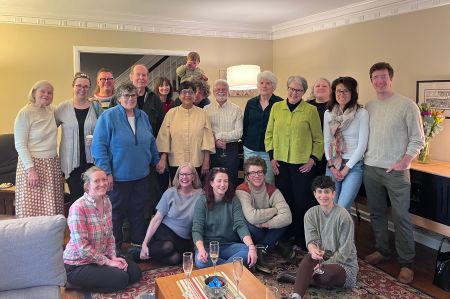
When past and present faculty came together to celebrate the retirement of Thrity Umrigar on a chilly May afternoon, the gathering was anything but cold. Ear-to-ear smiles, big hugs, and hearty laughs filled the room – a triumph considering the stress and busyness of the end of the semester. As each guest walked in, they looked around for Thrity, but it wasn’t difficult to find her. Just listen for the happiest tones in the Emmons-Claspy home and walk towards the joyful embrace of the guest of honor. This was not a party where guests were quietly sitting in a corner. Instead, all gathered around the bright light and warmth that has been such a positive force in the English department for the last twenty-four years. Thrity is special in this way; she makes people feel at ease. She is funny and profound; personable and sage. On the occasion of her retirement, we celebrate and remember all that Thrity has brought to the English department.
I had the privilege of working with Thrity from the first day of my graduate studies while taking her Toni Morrison class in 2009. I was unbelievably nervous, but Thrity put us at ease and helped us discuss and analyze eight of Morrison’s novels and her critical writing in a way that always made the 3-hour evening seminar fly by. When I was really fascinated by how Morrison defined the term “nurture” in her work, Thrity recommended several scholars who had explored Morrison’s work on motherhood. She was a constant cheerleader for graduate student work in the seminar, challenging us to strengthen our writing and to find the gaps in our research. Years later when I thought about asking a faculty member to chair my dissertation, I hesitantly asked Thrity. I was so fearful that she would not have room in her schedule, but I knew that she would be the best person to guide my project, and I am so grateful that she took me on and mentored me for years.
Thrity is an excellent role model of someone who constantly balances so many things. Thrity’s twelve novels, four children’s books, and many, many articles and interviews demonstrate her tenacity. She has explored a broad range of topics and genres, and her characters feel like neighbors. In her years at CWRU, she has taught graduate literature seminars, has led undergraduate creative writing courses, and has given more public lectures than I can count. When I attended her children’s book releases at local libraries with my young children, she spoke to crowds which included readers who have followed her career for decades and new fans who recently found her work for the first time. She spoke to everyone as if they were familiar friends and welcomed them in a way that encouraged them to want to read more.
As Dave Lucas states, “One of the qualities that makes Thrity so brilliant a writer is also what makes her so dear a person. That is a kind of empathy that can only be called radical. She looks for, and finds, the best in people. And so, in her writing, we meet the whole world there, and find it—and ourselves—ennobled. In her friendship, she turns no one away; she offers her hand or opens her door. Anyone who has been the beneficiary of Thrity and Eust’s hospitality know that this goes beyond any (admittedly delicious) meal. Theirs is a hospitality of spirit, and both the world of literature and the world at large need more of it.”
Mary Grimm recalls that “One of the things I most missed when I retired was dropping into her office to talk. Those talks ranged far and wide – our writing, our students, the state of the world, favorite shoes, longing for spring. We had different approaches to teaching (her approach was more structured than mine) but there were so many areas of agreement. I remember once she told me that she encouraged her students to live in their stories, that is to hold still in them, so to speak, to find out where their writing was going. That became something I quoted to my own students (with appropriate attribution, of course!).”
Former graduate student Mary Assad will never forget Thrity’s support of the community outreach projects that her graduate cohort organized. She writes, “Not only did she attend and support our various events, like bake sales, but she also encouraged and uplifted our work. I can still remember her chatting with my mom at an event, expressing her appreciation for these efforts and their integration within the English Department. This was a defining moment for me. Grad school leaves little time for “extra” projects that take one away from research and writing. Thrity reminded me that community engagement is at the core of what it means to be a humanities student. Of what it means to be human. This memory of Thrity is a steadfast light that will always stay with me, guiding my path.”
Over the last couple of years, I’ve had the full circle moment of teaching several of Thrity’s children’s picture books in my children’s picture book courses. A couple of semesters ago, a first year biology major wrote about Indian American representation in children’s picture books and highlighted Thrity’s Binny’s Diwali as a book she thought every child should read. She explained to her classmates that she desperately wished that as the only Indian American girl in an all-white school, she had had a book with a character who looked like her – just like Binny does. I remember watching this student’s heartfelt and smartly analyzed presentation with such joy. Thrity’s teaching and mentorship helped me find my way in academia, and I saw that her books have helped readers (including young adults and children) gain a mirror and see themselves where there have not been many previously.
Thrity is a beloved teacher, colleague, and friend, and her retirement has been met with enthusiasm by many of her recently retired colleagues who are excited for her to experience the joys of this next chapter – especially with the potential of traveling and fewer administrative tasks. Though I hope we will all remember her profound impact. As Mary Grimm expressed, “I loved how Thrity was always the person in faculty meetings who reminded us of the humans – the students, the lecturers – who would be affected by policy changes being discussed – something that sometimes gets lost in academic decision making.”
Thrity’s presence at CWRU will be sorely missed, though I look forward to reading her next book and hearing of her next adventure. Thank you, Thrity.
—Cara Byrne
Farewell to Susan Grimm
by Kim Emmons
Great assistants understand how the university works, run interference, and generally make life better for those lucky enough to work with them. Visited by yellow jackets? Here come the exterminators. Bathroom’s out of hand soap? Calls have been placed. Questions from graduate applicants? Handled graciously. Need an editor for your great aunt’s memoir? Referrals have been made. And, those challenges do not even touch the tasks that are actually listed in their job descriptions.
Susan Grimm has been the definition of a great assistant for the English department since she joined our front office team in 2010. She brought with her a wry good humor that has met the university’s administrative chaos with kindness, efficiency, and creativity. When she announced her intention to retire this June, I am sure I was not the only one who wondered what we would do without her.
Saying goodbye to Susan – this newsletter’s fearless leader, chief editor, and faithful story-finder – feels more than a little daunting. So, I have enlisted some help. As many of my co-conspirators would readily agree, English-types are a loquacious bunch, so what you see here are but brief excerpts of the tributes that have been offered.
● One of our secret pleasures was to have the occasional pretend meeting. We’d schedule a meeting and then hole up in my office with rosemary shortbread cookies from the coffee place in the Tink to gossip about our relatives and friends or talk about writing –my fiction and her poetry. (She is my first and best editor.) – Mary Grimm, Department Chair from 2009-2015
● It is a truth widely accepted that department chairs seek every possible means of offloading responsibilities. Perhaps less universally acknowledged is the fact that departments depend entirely on the grace, patience, and efficiency of their assistants who field such responsibilities. I certainly found these truths to be self-evident in my working relationship with Sue, who steadily counteracted my impulsive tendencies with her constitutional patience and good humor. – Chris Flint, Department Chair from 2015-2020
● What I remember most is the exceptional consistency with which [Susan] carried out her work, always with graciousness, efficiency, and composure. The steadiness and humanity she brought to the department every day made an immeasurable difference, and I remain deeply grateful for her support and quiet, reassuring presence. – Georgia Cowart, Department Chair from 2020-2022
● Susan’s reputation as a poet and poetry editor had preceded her, so I was delighted when I learned, in 2022, that I’d be working with her every day for the foreseeable future. We had a great working rapport: she took my antic disposition in stride and, in return, adamantly refused all my suggested changes to the website. Susan was patient with my late newsletter submissions, empathetic with my quixotic efforts to order new carpet for the front office, innovative with her water-drainage system, and generous with the quantity of her emails. All jokes aside, it was a joy to work with Susan, and I’ll miss her dearly. – Walt Hunter, Department Chair from 2022-2025
● Some of my favorite memories of working alongside Susan this past year have to do with writing. In the midst of juggling multiple administrative tasks, she maintained an uncanny ability to spot typos and grammatical errors within seconds of receiving a (probably late) newsletter submission. Even more than her keen editorial eye, I’ll miss Susan’s writerly generosity: her tips about fun local readings, observations about promising new poem prompts, and the occasional and always excellent book recommendation. – Chi Elliott, Department chair from 2025-present
● Over the years, Susan became more than just a colleague; she became a true friend. She will be greatly missed, especially the meaningful conversations we shared about life and family. As Susan begins this exciting new chapter, I wish her nothing but the very best. May her days be filled with quality time with loved ones, well-earned relaxation, and plenty of opportunities to read, write, and enjoy all the things she loves most. – Latricia Robinson, Department Administrator
Thank you Susan, for all that you have done for us; best wishes for your retirement!
Writing Program Awards

The Writing Program is pleased to recognize and celebrate the accomplishments of student writers and writing faculty at CWRU. Writing is fundamental to the work of the university: our words enable the development and circulation of knowledge, create and sustain our communities, and advocate for social and community action.
Teaching and Writing Awards 2026 here.
Paradise Lost Revisited


Students from James Newlin‘s ENGL 257B gave a public reading of the (abridged) poem Paradise Lost by John Milton on April 11th.
Concentrate on Journalism
by Ben Mauk
In Fall 2025, the English department launched a new journalism concentration for the English major. This has been a goal of mine from the moment I joined Case Western and I’m excited to see our offerings grow. Over the past two years I’ve had the pleasure of watching students produce accomplished works of feature journalism, essay, memoir, and oral history, all while learning from working professionals.
I’ve been a journalist for most of my working life. One of the most exciting things about teaching has been the opportunity to treat my classes as newsrooms and workshops: collaborative spaces where students learn the ropes through hands-on experience in reporting, editing, fact-checking, and publishing. We run editorial meetings to discuss story pitches and edit each others’ work, working as peers toward a common goal.
The highest achievement I hope for in my classes is to get students off campus and into the world, interviewing and reporting on issues that matter to their community. For much of the semester, we work on pitching, reporting, and writing narrative magazine articles. Our final projects this year blew me away. They included rigorously reported stories on a staggering diversity of subjects: local rehabilitation programs for formerly incarcerated people, the rise and fall (and rise) of Asiatown, Cleveland’s hockey culture following Laila Edwards’s 2026 Olympic success, the fight over the future of Burke airport, an oral history of a Lithuanian immigrant family, profiles of Cleveland’s Brazilian community and an experimental music collective, and immersive features on the Ohio & Erie Canalway and a longstanding Ohio mushroom farm.
Other students wrote in-depth stories on campus life: how the university fails its transgender students, what it’s like for graduating seniors entering a difficult job market, how the Sears think[box] transformed one local artist’s career, and a gripping triple-profile of three finalists competing in the Weatherhead School’s Morgenthaler-Pavey Startup Competition.
Publishing is not a requirement in my classes, but finding readers is journalism’s raison d’etre, and several students have sought opportunities to share their work with the public. This year, my Feature Writing class included staff members of The Observer, CWRU’s student newspaper, which published several class projects in abbreviated form. Other students are currently pitching their final projects to the Cleveland Scene, The Land, The Case Western Reserve Observer Magazine, and the Cleveland Review of Books, among other outlets. My fingers are crossed that you’ll see some of their work in the months to come!
Another highlight of teaching has been the opportunity to invite journalists and editors into the classroom to discuss their careers and field questions. Students reliably describe these visits as some of the most inspiring moments we spend together.
Our guest speakers have included:
–Sarah Schulman, novelist, Guggenheim-winning playwright, journalist, and AIDS historian. A major voice in American letters, Schulman joined my “Free Press and Protest” class to discuss her landmark book Let the Record Show: A Political History of ACT UP New York, 1987–1993.
–Vauhini Vara, writer, editor, and journalist. Vara’s novel The Immortal King Rao was a Pulitzer Prize finalist and winner of the Colorado Book Award. She is also a journalist for Businessweek, The Atlantic, and The New Yorker (where she was also my first editor). Vara talked about writing and editing as a career, and discussed “Bee-Brained,” her Harper’s Magazine feature about spelling bees and Indian-American identity—a perennial student favorite.
–Rosanna Xia, environmental reporter for the Los Angeles Times, documentary filmmaker, and Pulitzer Prize finalist. Xia joined our class while in town for the Cleveland International Film Festival, where she premiered her debut feature documentary, Out of Plain Sight. The film is based on her groundbreaking L.A. Times investigation into the illegal dumping of toxic waste off the coast of Los Angeles. After her class visit, several students joined Xia at the film’s premiere.
–Billy Lennon, founder, editor, and co-publisher of the Cleveland Review of Books. Lennon described the pleasures and challenges of running a small print magazine. We discussed how the CRB achieved a national reputation outside the NYC-centric media ecosystem while maintaining its focus on Cleveland-area writers and subjects.
-Freelance magazine writers Caitlin Chandler, Lauren Oyler, and Natasha Lennard, who discussed investigative stories they’ve written for The New York Times Magazine, Harper’s, and The Intercept.
–Madeleine Schwartz, award-winning journalist, writer, and the founder and editor-in-chief of The Dial. Schwartz talked about her recent feature for The New York Times Magazine, her experiences as an editor for the New York Review of Books, and what it’s like to run The Dial, a magazine of international writing and journalism focused on local voices.
Describing her own writing process, Schwartz gave some advice that gets to the heart of the discipline. “Bring back your ignorant self,” she said. By approaching each story with the curiosity of a newcomer, writing becomes a process of surprise and experiment. “We have more freedom than we think we do.” It’s a philosophy I’m excited to bring to the classroom next year.
Department News
Graduating English major Vida Barzdukas is featured in Art/Sci News.
Caren Beilin‘s story “UNDERWEARWASHER” is out with 3 Sisters Literary, a new magazine associated with the University of Pittsburgh’s MFA program.
On April 10th, Michele Berger gave a co-keynote “Pivots, Promises and Possibilities: Lessons Learned from Researching Women’s and Gender Studies Students’ Career Pathways for almost Two Decades” for the 50th anniversary of the Women’s and Gender Studies Consortium at University of Wisconsin-Madison.
Cara Byrne, Michelle Lyons-McFarland, Denna Iammarino, and Kris Kelly presented: “Make That Table Round: Multimodal Making and Inclusive Pedagogy in First-Year Writing” at the Conference on College Composition and Communication in Cleveland.
On Wednesday, April 22nd, Vicki Daniel participated in the panel, “Editing and Publishing the History of Contraception,” as part of the Skuy History of Contraception Series at the Dittrick Medical History Center. She served as an editor for the volume, The Nursing Clio Reader: Histories of Sex, Reproduction, and Justice (2025) and moderated the session. This roundtable discussion shed light on the processes of academic publishing and creating scholarly work for a public audience, as well as the joys and challenges of collaboration.
“Racing Ahead, Flourishing, Leaving a Trace like the Waves,” Joseph DeLong‘s translation of the second chapter of Ryoko Sekiguchi’s creative nonfiction book Nagori, has been published in the third volume of Richard Mille’s Hereme Chronicles.
Gusztav Demeter presented “Fostering Generative AI Literacy in a Genre-Based Writing Across the Disciplines Course” at the 60th RELC International Conference on Global Trends and Innovations in Language Education: Theory, Research, and Practice in Action in March in Singapore.
Adrianna Deptula presented with colleagues on a mixed methods research project at the Association of Teachers of Technical Writing (ATTW) conference. The presentation is entitled “Negotiating the boundaries of AI-detection: Pedagogical risks of false positives in the technical writing classroom.”
On May 7th, Chiyuma Elliott led a webinar titled “Shakespeare in Harlem” (about Shakespeare references in writing by James Baldwin and Langston Hughes) at the National Humanities Center for their “Humanities in Class” series.
On February 5th, as the recipient of last year’s AIQS Innovative Teaching Award, Nárcisz Fejes delivered a talk titled “Lessons in Discomfort and Gratitude,” which explored walking as pedagogy and as a practice of embodied attention to both physical and human communities.
Mary Grimm presented at the 41st Annual Western Reserve Writers’ Conference.
This June, Dave Lucas will return to the Oklahoma Summer Arts Institute as their instructor in creative writing.
Michelle Lyons-McFarland co-chaired a roundtable at the annual American Society for Eighteenth Century Studies conference in Philadelphia from April 8-11th. The session was for the ASECS Digital Humanities Caucus, and it was titled “DH DIY: What Do We Do When We’re All We’ve Got,” with a focus on crowdsourcing resources, money, and ways to be sustainable in the face of continually diminishing institutional support.
Ben Mauk‘s essay “From Beyond the Island: Edible Birds’ Nests in Borneo” is forthcoming in the second issue of GLOTTA, an annual print literary journal based in Hydra, Greece.
Marilyn Mobley’s book, Toni Morrison and the Geopoetics of Place, Race, and Be/longing, has been selected to receive the Toni Morrison Society Book Prize. The Award Plaque was presented at the ALA meetings in Chicago, during the African American Literature and Culture Society Reception, Reading, and Awards Ceremony on May 22nd.
James Newlin attended this year’s meeting of the Shakespeare Association of America in Denver. He presented a paper in the seminar, “How to Use King Lear.” He was also an invited speaker in a session on “Publishing in an Academic Journal,” as a representative of Borrowers & Lenders: The Journal of Shakespeare and Appropriation.
Gabrielle Parkin and Marion Wolfe presented: “Rethinking Required Writing Center Visits to Build Community Through Collaboration” at the Conference on College Composition and Communication in Cleveland.
Steve Pinkerton and Megan Jewell sat down on April 7th with Karen Kaler in the Harcourt House library for an episode of Kaler’s Pageturners webcast series. Their discussion focused on Colm Tóibín’s book Long Island (2024). Tóibín delivered this year’s F. Joseph Callahan Distinguished Lecture, in partnership with Think Forum on April 8th.
Xixin Qiu was awarded the Course Innovation Grant ($2500) from UCITE to further develop the course activities in his AIQS 100: Literacy Through Time: From Pens to Prompts.
Abigail Raley’s debut poetry collection, Wet Specimen, was released with Sundress Publications on April 28th.
Undergrad Jack Salit has been awarded a Rocks Experimental Learning Fellowship in Dublin this summer. Jack, a student in Megan Jewell‘s study abroad Ireland course, will be returning to Ireland to work on his project titled: “Mythos and Resistance: Folklore in Traditional and Republican Irish Music.”
Robin Beth Schaer‘s poem “From There to Here” was recently published in the Cleveland Review of Books, as part of this year’s Cleveland Humanities Festival which is focused on the theme of Freedom.
Martha Schaffer and Erika Olbricht served as Hospitality Coordinators, collecting key information about Cleveland and its many cultural and culinary gems at the Conference on College Composition and Communication.
Emily Sienkiewicz received a grant through the Flora Stone Mather Center to fund her research on Great Depression-era camps for unemployed women at the National Archives in Kansas City and at the FDR Presidential Library in New York.
Robert Spadoni presented “Kirk, Centricity, and the Original Star Trek” at the Society for Cinema and Media Studies Conference in Chicago in March.
Meredith Steck presented on a panel: “Demystifying Edited Collections: What We Learned in Five Years about Getting a Book Published” at the Conference on College Composition and Communication in Cleveland.
Lindsay Turner published an essay in The Nation on teaching poetry and AI (featuring her CWRU class).
Thrity Umrigar recently participated in the Los Angeles Times Festival of Books.
Pouya Vakili‘s paper, “From Awareness to Application: Examining the Effectiveness of Usage-Based Grammar Instruction on Adverbials,” was published by the Georgia Journal of Literacy.
Maggie Vinter led a seminar on “Silence on Stage” at the Shakespeare Association of America Annual Conference.
Spring in the Annex
Following the close of the exam period, the Annex spaces have fallen uncharacteristically quiet. April and May, however, found these spaces to be a hive of activity. Eight Mechanical Engineering students completed senior projects and presented them at Intersections, including CAD drawings for a future eighteenth-century common press replica and some demonstrations of 3D-printed type, laser-cut wood blocks, and replica sixteenth-century movable musical type.
Public activities concluded in Bellflower Hall with an open workshop for the CWRU community on Monday, April 27th, during which faculty, staff, and students made decorative paste papers, folded, sewed, and glued pamphlet-stitch books, and printed bookmarks.


How to Do Things with Books (English/Art Studio/World Literature 233/Jewish Studies 223) concluded with a final exhibition of student work on May 6th in the Guilford Dining Room. Family, friends, faculty, staff, and students viewed the semester’s projects and learned about the processes, influences, and ideas informing them.

At semester’s end, we say goodbye to the Annex intern for the past two years, Paige Erickson. Paige has left the Annex immeasurably better for her work, including the drafting of protocols, a course workbook, and organizational schemes! We also say our farewells for the summer to Nerya Freidenreich and Jack Rudofsky, who were critical to our sorting of Hebrew and Russian type. Christian Palios, volunteer sorter of Greek type and senior Mechanical Engineering student, will leave us after graduation as well.
This summer will involve adjustments to How to Do Things with Books in anticipation of the fall semester as well as a period of significant cleaning, reorganization, and preparations for expanded activities in 2026-27. We will benefit from the work of a summer intern as well as our volunteer corps, including the fabulous George Barnum.
We will be open for faculty, staff, and student work this summer on a modified schedule. If you want to come in to one of the labs, please email us at letterpress@case.edu.
–Kurt Koenigsberger
Alumni News
Will Allison (’91) is the recipient of a 2026 New Jersey Individual Artist Fellowship in prose from the New Jersey State Council on the Arts. The $16,000 fellowship was awarded based on an excerpt from his new novel, Snake Hill.
Gerry Canavan (’02) is now professor and chair of the English department at Marquette University in Milwaukee, WI. He is working on a book on J.R.R. Tolkien (among other projects).
Alum (’13) Evan Chaloupka‘s doctoral dissertation on disability in American literature (Dir: William Marling) is being published in October 2026 as Engaging Minds: Cognitive Disability and American Storytelling by the U. of Tennessee Press. Chaloupka is currently Fulbright Professor at the University of Tokyo.
Amy Kesegich, a 2001 graduate of the CWRU English PhD program and Professor of English at Lake Erie College, has published her first full-length poetry collection, Some Complaints About Time, with Finishing Line Press. The book releases September 11th.
Aquene Payne (’18) has been elected as Member at Large for the board of the Private Law Librarians and Information Professionals Special Interest Section (PLLIP-SIS) of the American Association of Law Libraries (AALL). She and two other law librarians will also be giving a presentation at the AALL national conference in July, entitled “Tracking with Aloha: Comparing Usage Tools for Law Library Insights.”
Brad Ricca (’02) and his newest book, Lincoln’s Ghost: Houdini’s War on Spiritualism and the Dark Conspiracy Against the American Presidency, is featured in The Land.
David S. Rutledge’s book about Joyce Carol Oates will be published by LSU Press this fall. He earned his PhD from CWRU English in 1997, working with Gary Stonum and William Marling, primarily.
Alum (’95) Sarah E. Turner‘s most recent book length publication is Critical Race Theory and the American Media; in addition to other chapters/articles, she also has a chapter in The Routledge Handbook of the New African Diasporic Literature (2024): “Chris Abani, the Anthropocene, and Transnational Ecoglobal Criticism.” She teaches at the University of Vermont.
Andy Zolot (’92) majored in English with a concentration in Film and was also a TA in Film (Louis Gianetti was his advisor). He produced a film that premiered at last year’s SXSW festival and was shown at this year’s Cleveland International Film Festival called Caper.
Send Me Your News

If you have news you would like to share in a future newsletter, please send it to englishnews@case.edu. If you wish to be added to our mailing list, just let us know. The department also has a Facebook page on which six hundred of your classmates and profs are already sharing their news. Become a member of the community and post your own news. We want to know. The department will be posting here regularly too—news of colloquiums, readings, etc. We tweet @CWRUEnglish. We are cwruenglish on Instagram.